
What Is Iwagumi Aquascape? How To Maintain It Properly?

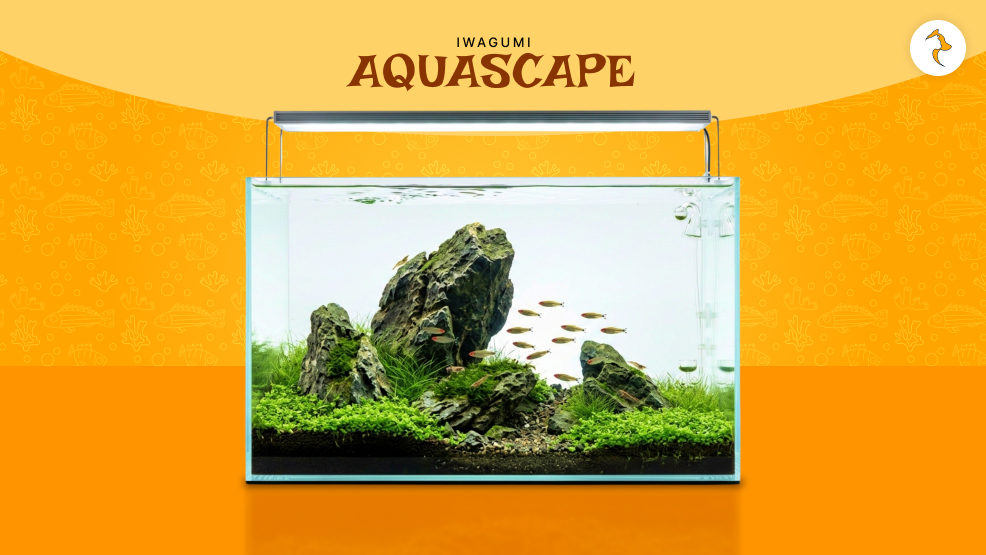
Literally, there are so many people in the aquascape who have been inspired by the famous aquarist Takashi Amano.
Taskashi Amano has taught us how to capture a small natural world in a glass box.
Amano inspired so many of us who are in the hobby today. He also introduced the aquarium enthusiasts to one of the most beautiful aquascaping styles known as iwagumi.
Moreover, the Iwagumi style reflects the importance of nature in Japanese culture and how it inspires people’s creativity.
In this article, we will learn the proper way to create and maintain an Iwagumi. We will discuss all the factors, such as CO2 injection, substrate, and the maintenance of parameters like GH, KH, and pH.
Most importantly, we will discuss the best plants and fish for Iwagumi Aquascape. Let us dive deep to create the most visually attractive Iwagumi.
What Are The Major Defining Features Of Iwagumi Aquascape?
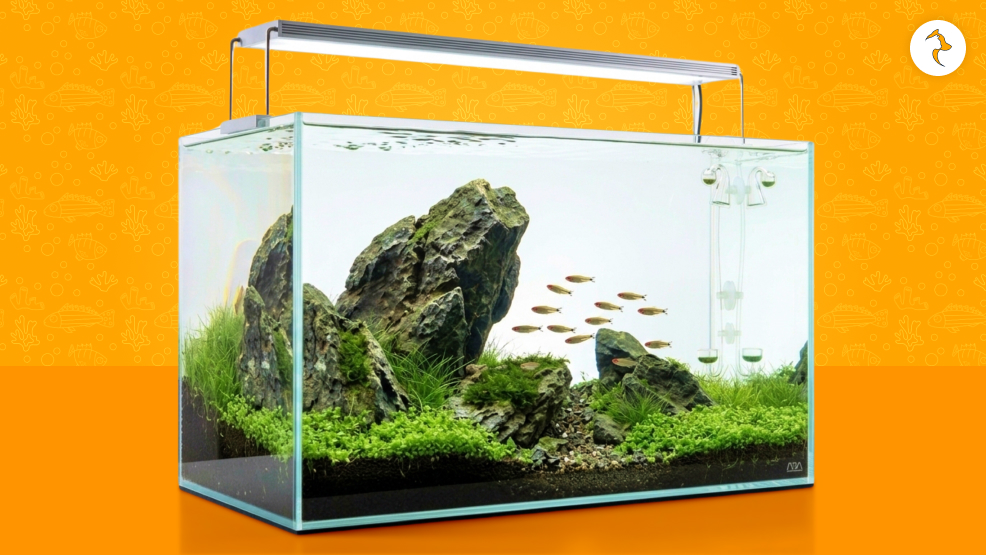
The concept of Iwagumi comes from the Japanese language and philosophy of stone, or rock arrangement.
The term Iwagaumi comes from two words of the Japanese language. One of which is “岩” (Iwa), and the other one is “組” (Gumi). Hence, both of them make “岩組” (Iwagumi).
“Iwa” (岩) means rock or stone, and on the other hand, “Gumi” (組) means arrangement, or formation.
Thus, Iwagumi is a type of aquascape inspired by nature and the formation of rocks.
Hence, rock plays the main role in your aquascape. The rocks generally provide the bony structure of the aquascape.
Moreover, conventionally, aquarists have been using three main stones. Hence, this includes one large headstone and two other smaller stones.
People mostly think that keeping things simple is easy. However, while executing, people find simplicity to be the most daunting task to achieve.
Hence, Iwagumi Aquascape cherishes simplicity. All the aquarists should keep in mind that it is not really about keeping a bunch of stones hapasartly.
You should place the stones in a more natural, fluent, and spacious manner to ensure the greatest delight for your eyes at first glance when you lay them in your aquarium.
What Is The Desirable Layout For Iwagumi Aquascape? Principles And Techniques
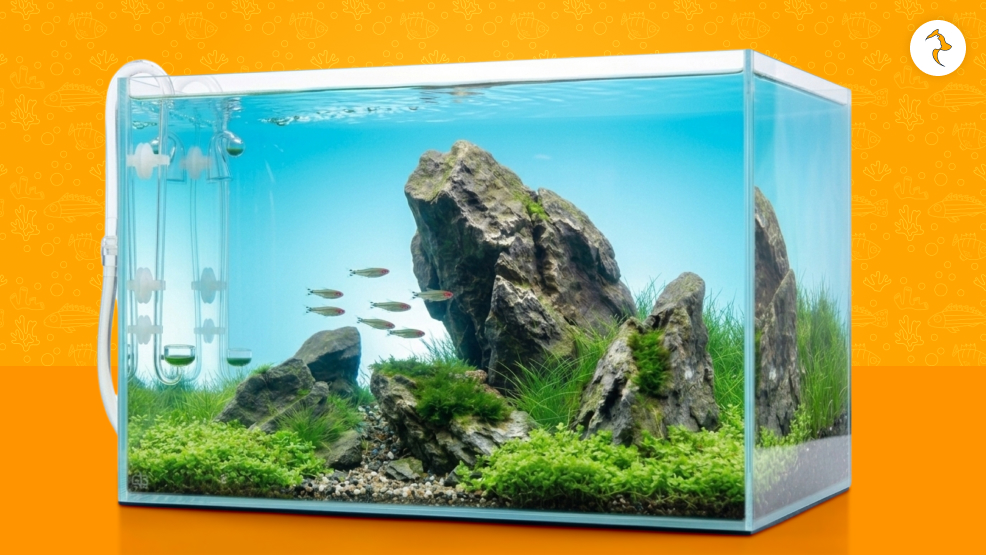
Conventionally, aquarists use a three-pillar rock formation for Iwagumi. However, Iwagumi Aquascape does not always follow the three rock formations.
Moreover, you can use multiple rocks for an Iwagumi. Only Sanzon Iwagumi uses a three-pillared rock formation.
But, Iwagumi generally follows a pattern that incorporates an odd number. Hence, you can use any number of rocks, such as 3, 5, or 7.
The Iwagumi showcases a juxtaposition that cherishes the beauty of asymmetry. Moreover, this is done to ensure a sense of relatability with Mother Nature.
Iwagumi generally uses stones like Seiryu-seki, Maten, and Shou. However, there is no strict rule for selecting rock types.
Moreover, you should aim for an odd number of rocks that are similar in texture and color. However, they should reflect diversity in terms of color and contour.
What Are The Major Rock Names Based On Their Placement In The Iwagumi Aquascape?
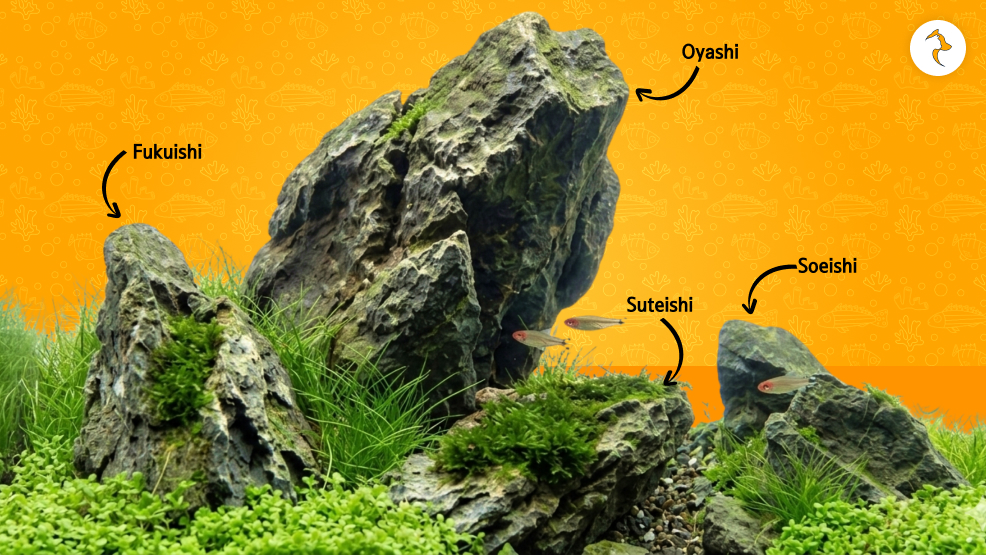
Each stone plays a specific role in the Iwagumi Aquascape. Moreover, these different stones have different names based on their positions within the landscape and on rock formation.
1. Oyashi
“Oyashi” acts as the primary stone in the Iwagumi. You should always place the “Oyashi” at the center or the focal point of your aquarium.
Moreover, the Oyashi should occupy two-thirds of the aquarium’s total height. Hence, the positioning serves the perfect ratio for the human eye.
This positioning follows the popular rule of thirds in photography. Moreover, the positioning abides by the “golden ratio theory”.
You can slightly tilt the Oyashi towards a direction in which the water flows. Hence, this offers a more natural-looking river stone appearance.
2. Fukuishi
Fukuishi is the second-largest rock in the Iwagumi Aquascape. You should always choose a Fukuishi that resembles the Oyashi in color and texture.
You should place the Fukuishi beside the Oyaishi. Moreover, the Fukuishi is the second most important stone.
3. Soeishi
The Soeishi is the third largest stone. Moreover, the stone is used to accentuate the strength and beauty of the first stone.
4. Suteishi
Suteishi is the fourth-largest stone in the Suteishi. The aquarists in Iwagami call it a ‘sacrificial stone.’
Moreover, this happens because the stone is often covered by the aquarium plants. However, Suteishi complements the entire formation of rocks.
Hence, this provides visitors with wholesome visuals. Moreover, the Sanzon Iwagumi does not incorporate Suteishi.
This form of aquascape generally uses only three rocks. Thus, the aquarists often omit Suteishi.
What Are The Most Suitable Plants For Iwagumi Aquascape?
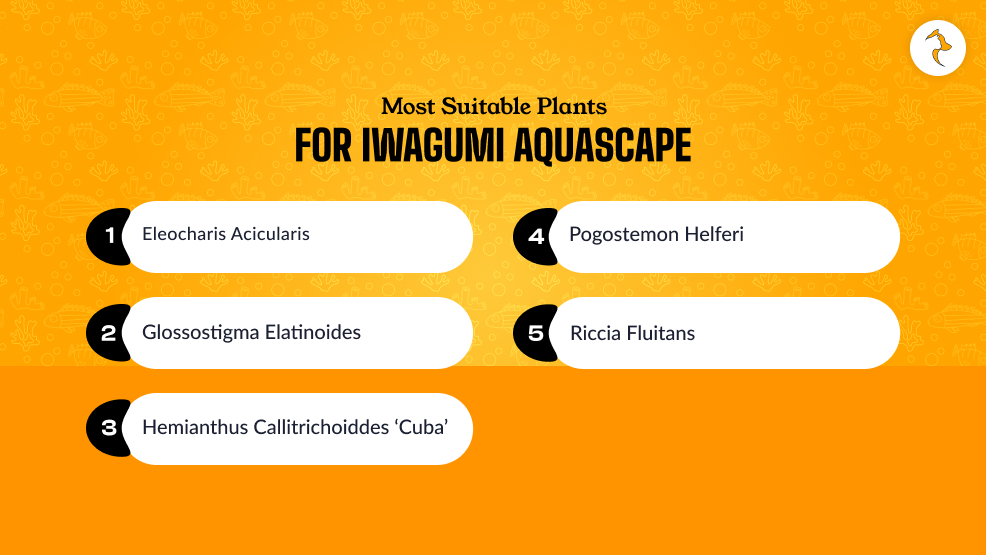
You can only use a limited type of plants while creating an Iwagumi. Moreover, the plants should not obscure the stones.
Hence, people should always focus on the stones. Additionally, there should be proper open spaces within the aquarium.
1. Floral Plants For Decoration On The Floor And Over The Rocks
You can use plants like the Dwarf hairgrass, scientifically known as “Eleocharis acicularis.” Furthermore, you can also use plants like Glossostigma elatinoides.
Additionally, you can also use plants like Hemianthus callitrichoiddes ‘Cuba’, which is also known as dwarf baby tears.
You can also use other plants for Iwagumi. The list of the other plants includes Pogostemon helferi and Riccia fluitans.
You can also tie these two plant types to a rock and submerge them in the water. Generally, the carpet of greenery makes the aquarium more attractive.
2. For The Background
For the background, you should use Vallisneria nana, Eleocharis vivipari and Rotala sp. Moreover, these plants are great for filling up the empty void in the background.
These plants are a little long. Hence, you should not place them Infront of the rocks.
Which Are The Best Suited Fish For Iwagumi Aquascape?
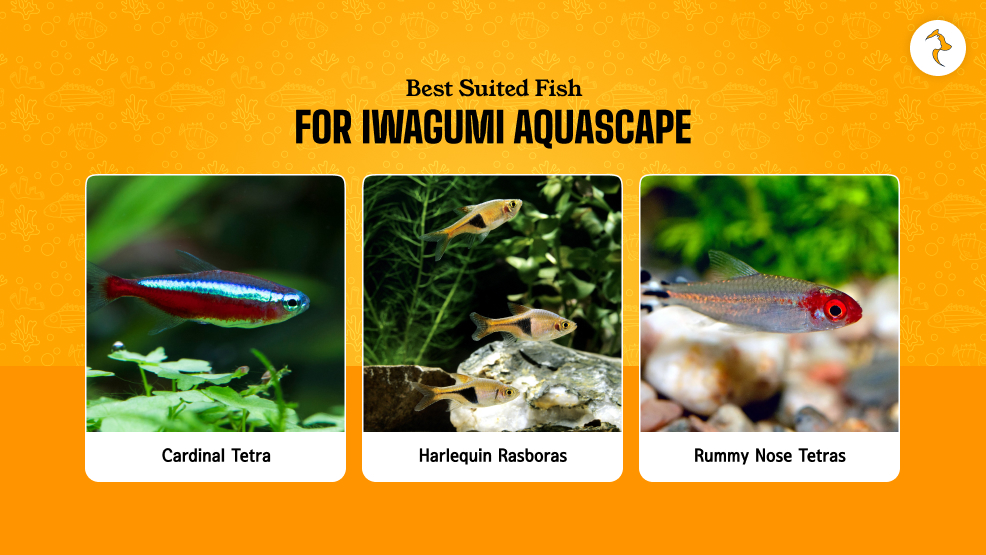
Schools of smaller fish generally tend to complement the vast empty spaces above the rocks.
Moreover, the collective flow of the school of the most colorful fish makes things really attractive.
A school of fish represents harmony. Thus, you should always avoid fish that remain primarily solitary.
You can incorporate fish like the cardinal tetra, Harlequin rasboras, Rummy nose tetras, and various others.
While you incorporate a school of fish into your tank, always avoid bringing fish like silver dollars and others.
A silver dollar can easily destroy your aquarium. Aquarists generally call the silver dollar plant piranhas for their nature of munching on plants.
You should also avoid other shoaling fish. They tend to remain solitary and often disrupt the tank’s harmony.
What Should The Ideal PH Of The Water Be In Case Of Iwagumi Aquascape?
Moreover, fluctuations in the PH levels generally occur due to several factors. Moreover, CO2 Concentration also plays a very important role in determining the PH levels of the water.
However, fluctuations in PH caused by the rise and fall of CO2 levels are common in nature.
CO2 generally builds up quite naturally in natural water bodies. Moreover, this happens due to organic decomposition.
Hence, the PH of the water bodies tends to drop. However, as soon as the sun shines on the water bodies, the plants start photosynthesis to remove CO2 from them.
Thus, PH fluctuations of up to 1 point are generally common in most planted tanks.
How Does The Rock Influence The KH And GH?
Yes, the use of rocks such as Seiryu-seki can definitely increase the PH levels of your aquarium water. Moreover, aquarists generally use rocks such as Seiryu-seki and Manten Rock.
These calcareous rocks generally increase GH and KH. Hence, these fluctuations affect the overall pH of the water in a planted aquarium.
Moreover, these types of rocks often increase the KH to around 4-10+ dkh. Hence, this is generally unsuitable for low KH tanks.
1. How To Avoid KH or GH Spikes In Your Tank?
You should perform a bucket test to avoid unwanted changes in your aquarium’s water parameters.
Measure the GH, KH, and PH of your water for several days after placing the rock in the bucket. Monitor the changes for several days.
Moreover, this will help you anticipate potential changes to your Iwagumi after adding rocks to your tank.
You can change the water in your tank. Further, reverse osmosis (RO) water lowers the baseline of hardness in your tank.
2. Which Are Alternative Neutral Rocks That Does Not Affect The Parameters Of Your Tank?
Some of the alternative rocks should not affect the chemistry of the water in your aquarium. These rocks include:
- Dragon Stone (Ohko Stone)
- Pagoda Stone
- Black Lava Rock
- Red Lava Rock
- Smooth Lava Stone
- Slate
Moreover, these rocks are generally pH-neutral. Hence, you can always use them as relevant alternatives.
How Important Is It To Inject CO2 In An Iwagumi Aquascape?
CO2 plays a very important role in plant growth. Hence, it is very important for planted fish tanks.
In nature, plants generally obtain CO2 from natural sources. Moreover, this includes the decaying plants, the fish exhaling oxygen, and others.
However, plants generally do not receive CO2 at such high concentrations in an artificial tank. Thus, it becomes very necessary to add CO2.
The Iwagumi style generally replicates lush greenery, such as bushes and forests. Thus, CO2 in water plays an important role.
Hence, the fish and plants living in this natural setup become very much accustomed to these fluctuations.
But you should determine the ideal pH levels in your aquarium based on the needs and requirements of the fish and plants in your tank.
The ideal pH for an aquarium should be between 6.0 and 7.0 or 6.5-7.5. However, you should determine these things based on the types of plants.
1. What Is The Tight Amount Of CO2 For Iwagumi Planted Fish Tank?
The optimal amount of CO2 injection depends mostly on the size of your tank. Hence, you will have to add CO2 in larger quantities in a larger tank.
On the other hand, smaller tanks require less CO2. Also, adding CO2 depends on the amount of fauna in the system.
You should add more CO2 if you have more plants. At the same time, fewer plants require CO2 in smaller quantities.
Moreover, you should use at least 20-30 parts per million (PPM) to enhance plant growth in your aquarium. Moreover, you should also keep in mind the safety of your fish in this process.
You should start with a very low injection rate. This should be like one bubble per second, and then gradually increase it while monitoring the condition of the fish in your aquarium.
Hence, you should add 1-2 bubbles per second to a 50-gallon aquarium. Here is a table to help you determine the correct amount of CO2 to inject based on your tank’s size.
| Tank Size (Gallons) | Approx CO₂ Bubble Rate (Bubbles/sec) |
|---|---|
| 50 gallons | 1–2 BPS |
| 100 gallons | 2–4 BPS |
| 200 gallons | 4–8 BPS |
| 246 gallons | 5–10 BPS |
You should always use a CO2 Drop Checker (4 dkh solution) to monitor CO2 levels in the tank. Near green (∼30 ppm)
2. What Is The Right Way To Inject CO2 In Your Iwagumi Aquascape Tank?
Add CO2 only when the lights are switched on. Hence, this will allow the plants to do photosynthesis properly.
Add it at least 1.5 hours before switching on the lights in your aquarium. Do not exceed 6-8 hours of CO2 timing in your aquarium. Always maintain the schedule while using CO2 on your Iwagumi.
Which Is The Right Substrate For Iwagumi Aquascape?
The plants used in Iwagumi generally absorb a large amount of nutrients from the soil. Thus, it is important to use high-quality Aquarium soil, such as ADA Amazonia.
People often suggest mixing aqua soil with garden soil. However, you should not compromise on the substrate quality.
A low-quality substrate should not provide your fish tank with the proper carpet effect.
What Are The Major Challenges In Iwagumi Aquascape?
People think that maintaining an Iwagumi is really easy. However, that is not always the case.
However, you will find it very difficult to create while aqua scaping. Furthermore, people find it even more difficult to maintain it.
Moreover, the limitations in the plant sector make aqua scaping even more difficult for the aqua-scapers.
The plants used in the Iwagumi generally feed heavily through their roots. Thus, it becomes even more important to choose the right substrate for Iwagumi.
Frequently Asked Questions (FAQs)
Here are the answers to some of the most commonly asked questions about Iwagumi Aquascape.
People often underestimate the total amount of effort required for Iwagumi. Hence, Iwagaumi requires extensive effort to be maintained properly.
CO2 injection plays a very crucial role in maintaining the lush green carpet effect in floral plants. However, you should inject CO2 properly. Add CO2 at 20-30 parts per million.
Plants like Dwarf hairgrass Glossostigma elatinoides, Hemianthus callitrichoiddes ‘Cuba
dwarf baby tears, Pogostemon helferi, Riccia fluitans, Vallisneria nana, Eleocharis vivipari and Rotala sp are great for Iwagumi
Share








Leave A Comment