
Why Is My Dog Walking In Circles? Causes, When To Be Worried, And What To Do


Disclaimer: The advice provided in this post is intended for informational purposes and does not constitute medical advice regarding pets. Please make an appointment with your vet to accurately diagnose your pet’s condition.
Dogs are strange, aren’t they? Whether it is sniffing another dog’s butt, walking in circles, or running into zombies, our dogs are never shy about being quirky.
It is one reason that we love our pets. But having said that, it is also possible that there is an underlying health condition that you should not ignore.
And your dog walking in circles? Might just not be a quirky behavioral trend – there could be more to it than it initially appears to be.
And that is precisely why I’m here – to help you understand what it means, what can you do, and how to ensure there is nothing wrong with your pet.
Stay tuned.
Dog Walking In Circles? Top Symptoms

Obviously, a common symptom of a dog walking in circles or pacing around is precisely that – your baby pacing and circling. But there’s more to this than meets the eye – at least initially. And some of these symptoms aren’t always easy to recognize.
In fact, the symptoms of such compulsive behavior, especially in dogs, tend to differ, and not every dog will show the same signs.
On that note, I’ve laid down certain behavioral patterns in your dog that you should notice in relation to circling around unnaturally:
- Your dog keeps pacing or circling even after you have taken them for alternative activities such as walking or playing.
- Disorientation or confusion.
- Wandering around aimlessly.
- Changes in behaviors and sleeping habits.
- Changes in the manner of walking.
- Appetite changes. (it can increase or decrease)
- Changes in habits, especially related to daily living.
Apart from these changes, you can also check out if your dog is showing any compulsive behavior, such as tail chasing, spinning, excessive licking, barking, fly snapping, etc.
The worst part? It may appear to be funny or even cute when your dog displays some of these behaviors, or when they are actually chasing something around. But having said that, it is vital to note that it might not be an intentional way to get attention.
Instead, it can be a signal for something more serious and deeper – a problem that needs to be evaluated and treated – sooner rather than later.
Dog Walking In Circles: What Are The Major Causes?
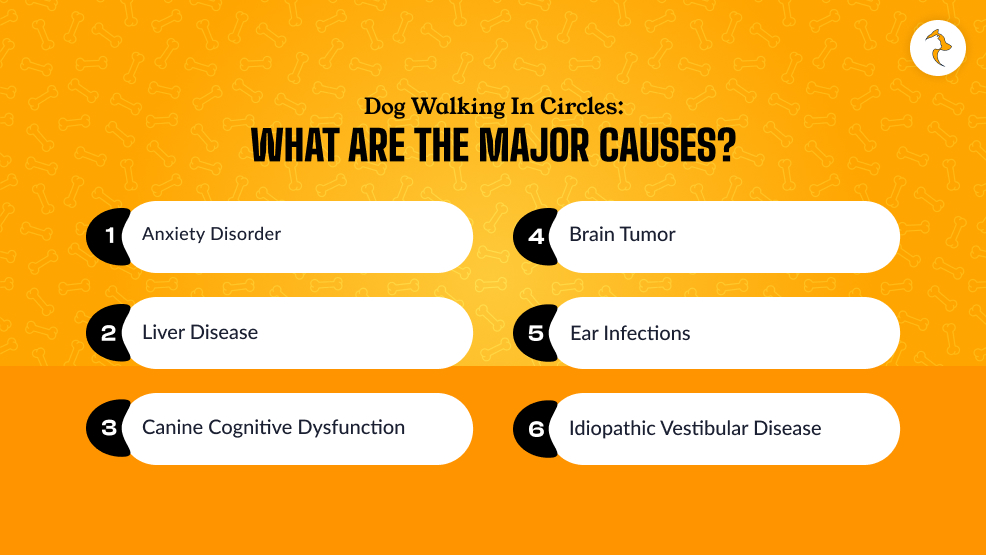
So, the main question here is: what is causing your dog to actually walk in pace around or walk in circles?
While certain occasional circling and pacing is often considered to be normal behavior, if it is happening every now and then, it is possible that there is something deeper – something that needs attention. Also, it could trigger compulsive behavior.
In this context, the potential causes behind a dog walking in circles could be as follows:
1. Anxiety Disorder:
Anxiety disorder in dogs can happen due to multiple reasons, including:
- Fear of loud noises like fireworks.
- Too little space for the dog to run around.
- A lack of physical or mental challenge.
- Something genetic that causes anxiety.
- Post-traumatic event from being remembered.
- Pain from some past injury or other conditions.
- Canine Compulsive Disorder. This is very similar to human compulsive disorder – in this case, your canine is more likely to exhibit repetitive behavior.
2. Liver Disease:
Liver disease in dogs can result from more than one cause. This includes:
- A damaged or diseased liver can cause neurological problems that could lead to circling, pacing, head pressing, or even behavioral changes.
- Certain parasitic infections and Hepatitis can lead to neurological problems.
- Neurological damage usually takes place when blood gets shunted inside the liver, enabling toxins to increase in the kidneys and the bloodstream.
3. Canine Cognitive Dysfunction:
Canine Cognitive Dementia leads to brain deposits similar to those in humans. The symptoms in this case tend to vary and often include disorientation in a dog. Moreover, this further leads to unnecessary pacing, barking, circling, and restlessness.
4. Brain Tumor:
When a dog walks in circles, paces around, and exhibits any other repetitive behavior, it is caused by some neurologic changes. How does it happen? When the tumor grows, it exerts a certain amount of pressure on the dog’s brain.
5. Ear Infections:
Fungal, parasitic, or bacterial ear disorders can easily impact the dog’s balance centre. This, in turn, can lead to disruptive behavior, including restlessness, head tilting, and circling. Moreover, ear infections can be a primary cause behind a dog pacing and walking in circles.
6. Idiopathic Vestibular Disease:
Idiopathic Vestibular Disease is one disease that is mostly visible in somewhat older dogs. Having said that, dogs who suffer from this disease also recover from the same within a handful of days. However, some dogs might have long-lasting effects, including a mild head tilt that doesn’t go away.
How Does Vets Diagnose A Dog’s Disorientation, Walking In Circles, And Pacing?

As I was just saying, if your pet is displaying symptoms of disorientation, including walking in circles and pacing, it could be due to multiple reasons.
As a result, you have to understand that diagnosis is not really going to be quick or easy. So, it’s best to be ready – this might not be that simple, and definitely more complex than a quick blood test.
So, your vet, or even the attending vet, will need your dog’s complete medical history. Generally, this includes your dog’s living arrangements, exercise habits, and diet. And that’s not all.
Also, you need to tell the vet if your dog has any existing health conditions or injuries, where they go to exercise, and anything else that is related to the symptoms you have seen your pet displaying.
Moreover, you need to highlight whether the symptoms have appeared suddenly or gradually, and the subsequent severity of the same.
After your vet gets your dog’s medical history, they will do a thorough medical examination and follow it up with potential blood, urine, and faecal tests.
Also, depending on the severity of the situation, your vet will also do radiography, MRI or CT imaging to find out if your dog is displaying any unnatural or clinical symptoms.
Once your vet receives the different test results, they will evaluate them and come up with an appropriate plan to treat your dog – but only if your dog does have some clinical issue.
Treatment For A Dog’s Disorientation And Walking In Circles:
It is obvious that your vet’s treatment options will depend entirely on what is causing your dog’s unnatural walking in circles and pacing.
In case the vet finds a clinical or systemic medical condition, then the treatment options will include alternatives consistent with the type of disease. What do I mean by this? For instance, if there is any infection your dog is suffering from, then the treatment can include oral medications to treat the same. Similarly, for something more serious like a tumor, the treatment can include surgical options.
Moreover, if the vet finds issues with the dog’s diet, then they will make suggestions about dietary changes to treat the issue. Similarly, for behvioral conditions, the treatment would include changes in living conditions, a stress-free routine, and behavioral training.
Having said that, it is vital to note that canine dementia is incurable. But you can certainly manage it if you can make the right changes in the environment, supplements, and diet.
Will My Dog Stop Walking In Circles?

The question is: will your dog recover? This constant pacing around and walking in circles – will this ever go away?
Ultimately, it depends on why it is happening and the diagnosis – it is determined by your vet. For some causes, the treatments typically depend on certain factors, including your pet’s age, lifestyle, and ongoing medical issues.
Moreover, for other reasons, it might be a simple solution that often fits the bill, such as ensuring your dog gets more exercise, training, and play time. This will keep his mind very active – or it could be just about changing his daily diet.
Having said that, in all events, dispensing a substantial quantity of the three golden A’s – attention, affirmation, and affection will always ensure effective treatment for your dog.
Frequently Asked Questions (FAQs)
Check out the most frequently asked questions related to a dog walking in circles:
If your dog keeps walking in circles before lying down, it’s mostly ancient instincts passed down from their wild ancestors. The idea is to find a comfortable, safe space to rest by flattening the grass or snow around. Moreover, it also involves checking for different threats like predators and snakes, marking such spots, or simply regulating the temperature.
Yes, dogs are prone to getting the ‘circling’ disease. However, it’s not a singular disease but rather a sort of symptom for more underlying (and serious) issues, most notably CDV or Canine Distemper Virus, which can lead to brain inflammation. Also, it could be due to Canine Vestibular Disease, which can impact balance or cognitive decline.
To comfort your dog with vestibular disease or vertigo, you can create a quiet and safe space. Moreover, consider offering gentle reassurance, being present, and supporting your dog’s mobility with assistance and soft bedding for potty breaks. Moreover, you can also contact your vet professional for diagnosis and potential anxiety or anti-nausea meds.
Yes, circling in your dog can mean your pet’s stressed, overwhelmed, or anxious, specifically if it’s frantic, excessive, or paired with whining, restlessness, trembling, or panting. But it is a natural instinct to prepare a rest spot or a nesting. So, search for accompanying symptoms to distinguish between normal prep and anxiety.
Share








Leave A Comment