
Essential Puppy Training Tips To Survive the “Land Shark” Phase: How To Train A Puppy Not To Bite?

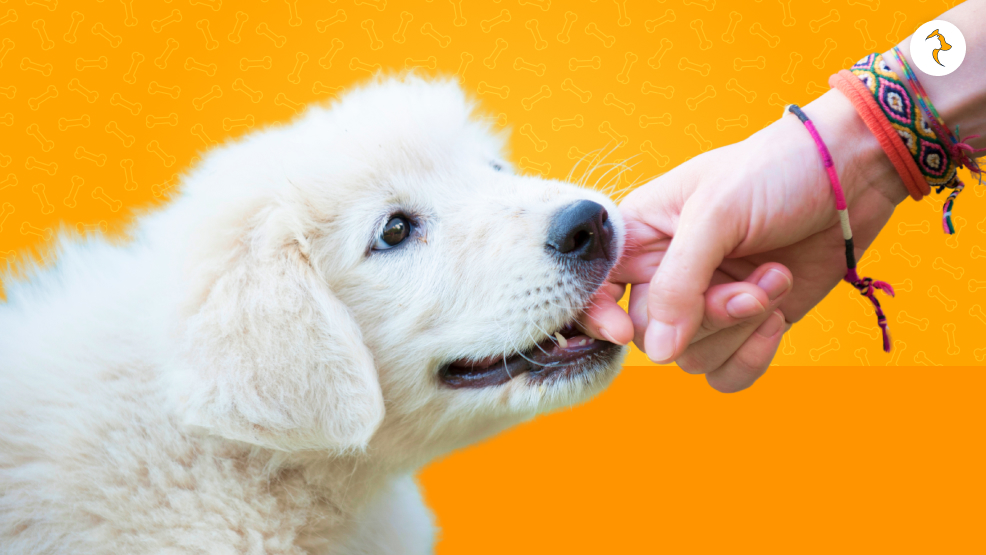
Dog parents often wonder how to train a puppy not to bite. However, they should understand that the puppies are like babies. Therefore, you get an ample amount of time to teach good manners to your baby. But people often forget how fast a puppy grows into a dog.
Thus, if you miss out on that time to fix your dog’s behavior when it is a puppy, you are literally setting yourself up for a menace for the next 10 to 18 years.
Thus, the dog parents, especially the new ones, should not miss out on this time. They should immediately learn to communicate with the puppy. A puppy’s conscience is shaped as it grows into a dog.
Thus, this is the time when dogs learn how to interpret things. Moreover, they slowly learn how to interact with human beings.
Puppies should understand the difference between appreciation and agitation, as well as other ways humans express themselves.
Here are the Essential puppy training tips to survive the “ Land Shark Phase” in puppies.
Understanding The Golden Rule Of Puppy Learning: Learn How To Train A Puppy Not To Bite
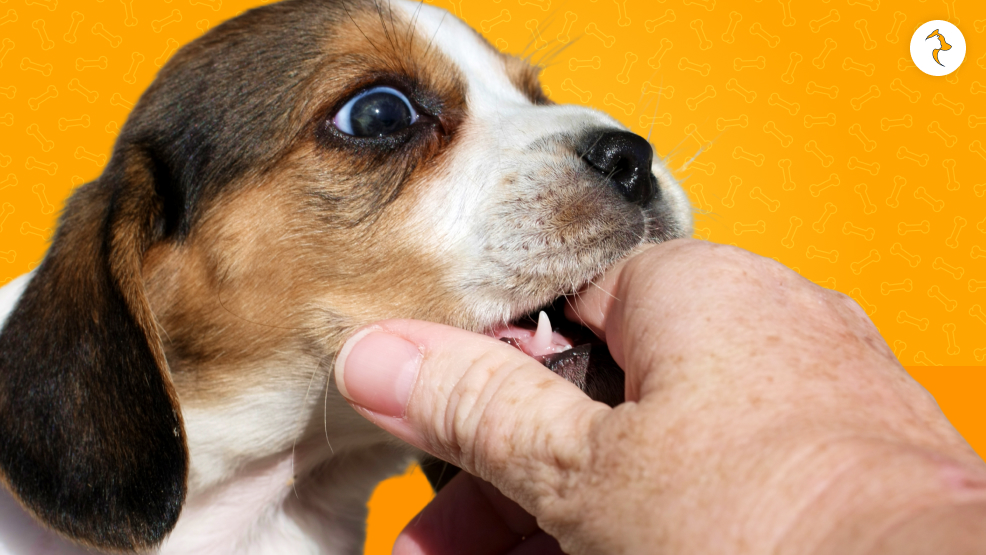
Here are the golden rules of puppy training. These rules will help pet parents better understand their pups’ behavioral patterns.
When dog parents better understand their dogs’ behavioral patterns, they communicate more effectively with their furry toddlers.
1. Consistency Is One Of The Most Important Puppy Training Tips
Consistency plays a key role in habituating canines. Moreover, it is important to ensure they do not receive confusing instructions from others. The family cannot send mixed signals. For example, if you pretend to be ok with your dog biting you while you are playing with it, and then suddenly get angry when it does the same thing when you are working. They will find it to be confusing.
Puppies understand less. Thus, whenever they try to bite your skin, express anger, and stop having fun, no matter how playful the bite may feel. Reply angrily and say no.
Hence, when you wonder how to train a puppy not to bite, always remember that consistency helps them to learn things.
2. 3 Seconds Rule
Immediate feedback remains crucial. Thus, whenever the dog does something wrong, say ‘no’ to it immediately and quite angrily. People often show anger or agitation toward the dog 10 seconds after it has done something wrong. Thus, the dog has already dissociated from it by then.
While you try to figure out how to train a puppy not to bite, you should take immediate action, and that too within just 3 seconds.
3. Implement A Routine To Keep The Puppy Disciplined
A properly structured day, shaped by a disciplined routine, reduces anxiety in the puppies. Thus, the puppies stop indulging in bad behavior. Puppies behave calmly when they can predict what is going to happen next.
The day should have specific times for feeding, potty breaks, playing, fun, and then a nap.
How to train a puppy not to bite? Implement a proper routine.
Understand The Bite: Learn Why Puppies Target Hands And What Different Types Of Bites Mean?
While you wonder how to train a puppy not to bite? Understand why does your puppy targets your hands specifically. Parents should learn about the triggers to identify the behavioral pattern they want to stop. Understanding the types of bites is one of the most important puppy training tips that dog parents should keep in mind.
There are generally three types of biting. These bits include things like Teething, Play, annoyed, Tired, and agitation.
1. Teething
When the puppies grow new teeth, they have their instincts to bite, or rather, chew on something.
Thus, puppy-safe toys that help control sensation are helpful for people to help fix irritation in puppies.
2. Play Biting
Play biting gets initiated by play bows in the puppies. Thus, people often interpret it to be some kind of ferocious activity. However, the puppies remain playful, and they do not mean to harm anyone.
3. Over Tiredness
Puppies often bite a little when they are tired. Moreover, during these times, the puppies revolve around in circles.
Trying to train the puppy right now will only annoy them, not help them. Thus, the puppies need to sleep immediately.
Puppies need to get at least 18-20 hours of sleep in a day. Thus, the owners should put the puppy in a crate when they see it is over-tired.
How To Teach Your Puppy Not To Bite?
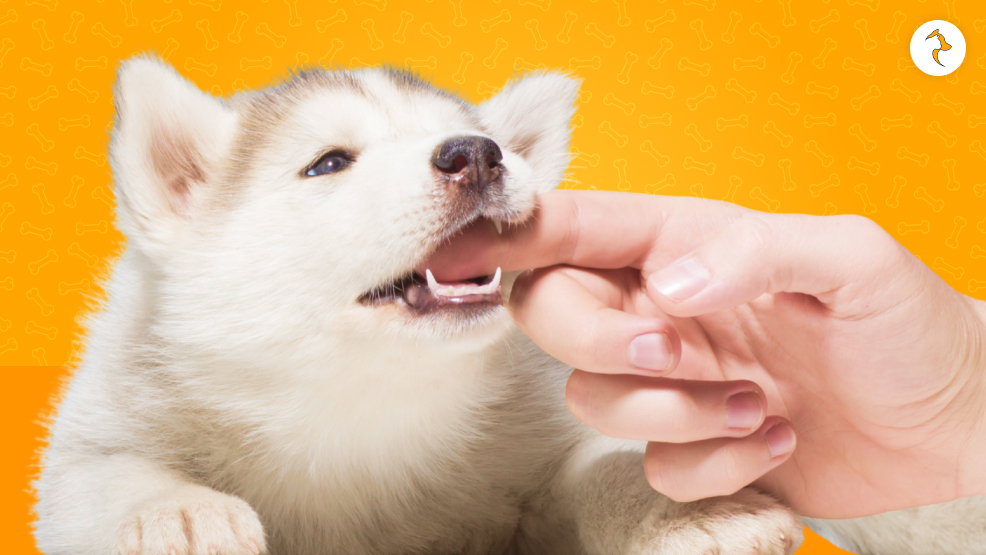
There are multiple ways and methods to teach a puppy not to bite. Moreover, the intention is to ensure they do not harm those around them. Here are the main steps.
1. Teaching The Puppy Bite Inhibition: Puppy Training Tips
The dog parents should remember that we have hands. Thus, human beings generally find it uncivilized to use their mouth to pick up things. However, unlike us, dogs use their jaws to handle or grab everything around them.
Thus, the puppy has to learn how much force to apply. Slowly, they learn how to interact with the world and understand how much bite force is actually harmful to those they are interacting with.
The bite force slowly becomes gentle as they learn how much pressure to apply. This is like teaching the puppy to drive.
When the puppy bites hard, let your hand go limp. Then give the puppy feedback with a specific sound. Thus, the sound should act as a warning, and you should stop playing immediately.
Then, the puppy will start mouthing gently. Slowly, then you can teach it mouth-only when necessary. How to Train a Puppy Not to Bite? Slowly introduce your puppy’s bite inhibition.
2. The Redirection Method (Texture Matching)
People will have to understand the behavioral pattern of a dog’s bite. Thus, the choice of toys primarily depends on the material the dog is chewing.
The puppy needs a plush toy type of thing when they bite onto skin. On the other hand, they need a bully stick or a rubber Kong when they are biting furniture and other objects.
Finally, a rope toy redirects a puppy’s chewing behavior when it is messing with fabric and other objects.
3. How to Train a Puppy Not to Bite? Through The Reverse “Time Out”
Pet parents should ensure their dogs properly interpret their signals or language. Most people think that yelling “ouch” will save their hand. However, this may not work at times.
Some breeds of dogs have a predatory nature, as they have natural hunting instincts. Thus, these breeds can often be more triggered by a high-pitched “ouch” because it mimics the sound of a dying animal.
Thus, a firm “no” can establish dominance and improve the situation.
Dogs and puppies generally do their best to grab your attention. Thus, whenever they do not get the attention they seek, they feel sad.
The ultimate punishment for the puppy is to leave the room while assertively saying no to his behavior. They should understand that this behavior shall not be entertained.
Understanding Why Different Types Of Breeds Bite Based On Their Nature And Instincts, And Also Learn How to Train a Puppy Not to Bite
Puppy training tips include understanding that Different dog breeds bite for various reasons, as they inherit diverse traits based on their instincts. Let’s understand why other species of dogs bite and what exact instincts they have. Also, learn the solution to control the puppies.
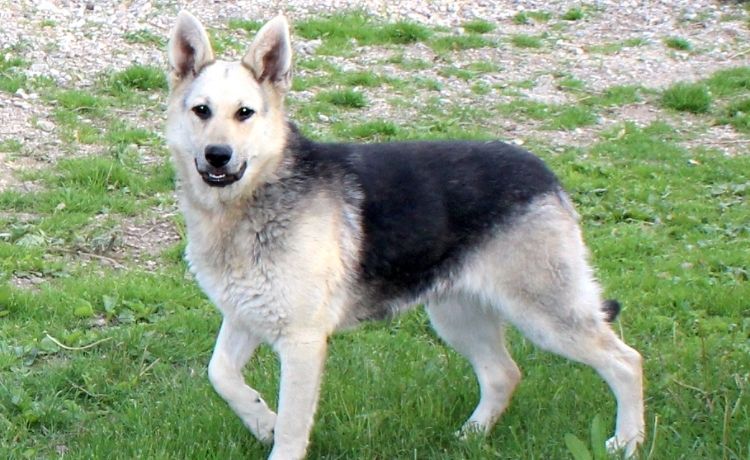
1. Shepherd Dogs
The shepherd dogs have the instinct to control the movement of other creatures around them. Thus, shepherds often nip the pants or the heels to control people’s movement.
Moreover, they see you as cattle that they have to control. The dog parents should make them understand that they are not a herd of cattle.
The dog owners should stop moving, as any movement actually triggers the dog’s biting instincts.
2. Retrievers
Retrievers are friendly, interactive, and naturally curious. The retrievers often use mouthing to explore things. The retrievers generally want to hold on to you. Thus, they usually tend to hold you with their mouth.
The dog’s parents should go for the pacifier trick. Thus, whenever they greet you, they should have a toy in their mouth. Hence, in this way, they will not want to bite or hold on to you as they have something to hold on to.
The retrievers are attention-seeking and affectionate. Thus, they should be treated accordingly.
3. Terriers
Some of the breeds have inherited hunting instincts. Thus, these breeds generally have high prey drive. The Terriers typically have a tugging instinct. Whenever they do such things, yell it out loud, “drop it”.
Do not try to play “tough of war” with your clothes and others. Simply, handle it with firmness.
4. Working/Guard Dogs
Working or guard dogs generally have an instinct to exert dominance over others. They generally try to prove that they are the supreme. The guard dogs often try to push their boundaries and dominate.
The owners should not apply to something like free training. Thus, the dogs should wait before getting anything, such as food or even affection. Moreover, they should understand that they will only receive affection when they behave in the right way.
The dog’s parents should specifically make their dog sit as they open the door. Thus, this ensures the dog’s behavior remains calm and composed. This prevents bad behavior outdoors or right after the owner enters through the doors.
How to Train a Puppy Not to Bite Your Children?
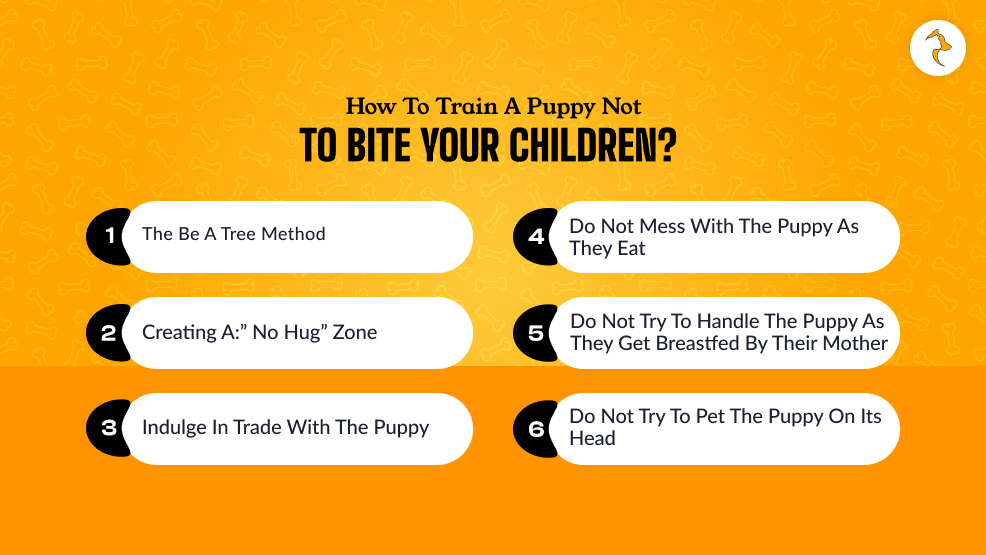
The dog parents want their puppies to do well with their family and others. Puppies should get along well with children. Otherwise, this can result in hazards in the future. Here are some of the puppy training tips that shall prevent the puppy from creating problems with your family, especially children.
Children often make high-pitched noises. Thus, the puppies usually see them as big, walking, talking toys. Here are some of the methods that you need to teach your children so that they can deal with the puppies safely.
1. The Be A Tree Method
The children should not run and scream around the puppy when it tries to chase them. Moreover, this increases a puppy’s chase instinct. Thus, the children should rather stand still like a tree.
Moreover, this will take away the puppies’ excitement. The kids should fold their arms. Thus, children should keep their arms out of the puppy’s bite radius. When the dog behaves aggressively, they should watch the sky and look around, ignoring the puppy’s presence.
The puppy gets bored and walks away because people do not react to what it does. Thus, this prevents the ferociousness in the dogs.
2. Creating A:” No Hug” Zone
Research suggests that over 80% of the dog bites to young children are from the child interacting with the dog in various ways. This information was sourced from wearefamily.nsw.gov.au. The dogs remain interactive in multiple ways. However, the dogs do not like being touched in certain ways.
The dogs often bite children as they try to hug them. Dogs act as cursorial animals that love to run. However, when children wrap them in their arms, they feel trapped. Thus, this causes the dogs to bite children.
3. How to Train a Puppy Not to Bite? Indulge In Trade With The Puppy
Children often try to steal things like toys right from the mouth of the puppy. This annoys the puppy, and they can bite instinctively. Parents should teach their children to offer a high-value treat to the puppy and then wait for it to drop the toy. This will, moreover, avoid any aggression from the dog.
4. Do Not Mess With The Puppy As They Eat
Children often try to interact with puppies when they are eating. Thus, puppies see this as a threat to their food. They think the child has come to steal food from their plate. Thus, the parents should be aware and prevent their children from indulging in such behavior.
5. Do Not Try To Handle The Puppy As They Get Breastfed By Their Mother
Several families often have to take care of the mother of the puppies. Thus, the children often try to interact with the puppies as they get milked by their mother. Moreover, the children end up triggering the mother of the puppies as she gets protective of them.
6. Do Not Try To Pet The Puppy On Its Head
Children should avoid touching the puppy on their head. Moreover, touching the heads of the puppies will trigger them. This can often lead to a problem. Touching the dog like this puts the child directly within the bite radius of the puppy.
The puppies of growing age can provide a fatal bite to a young child. Thus, people should keep children away from older puppies.
Frequently Asked Questions About Puppy Training And How to Train a Puppy Not to Bite
Here are the answers to some of the most commonly asked questions about puppy training tips to prevent it from biting.
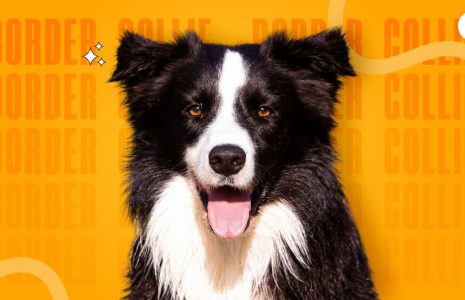
Certain high-pray dogs like Border Collies and Shepherds often consider an “ouch” as the moaning of a prey. Thus, the “ouch” further triggers their hunting instincts. Therefore, the dog parents often fall for this common misunderstanding.
There are multiple signs that can show that your puppy is actually getting aggressive. Moreover, the list of signs includes things like overstimulation or play. Thus, this includes play biting, bouncy body, play bows, and several others.
However, true aggression shows multiple other signs. This includes a Stiff body, hard staring, ears pinned back, curling lips to show teeth before the bite, and a low, continuous growl.
The puppies are toddlers who do not really understand when to sleep properly. Thus, they often get exhausted without even understanding. The dog parents should put them in a surrounded environment with something soothing to chew.
The “land Shark” phrase typically starts at 4-5 months. Moreover, the land shark phrase is at its peak when the dog is 3-4 months old.
The biting mostly happens due to teething and swelling of the gums. However, this tenderness fades as the adult teeth fix. Moreover, this happens by six months.
The herding breeds often try to control the walking pattern of people while making them walk in a certain way. However, the dog parents should not move. This will exhaust the excitement in a dog and will make the situation boring. Thus, the puppy shall lose interest.
The use of physical force or physical punishment scares the puppy and breaks their trust. Thus, distrust often leads to aggression and cynicism.
Removing the reward, such as food, will discipline the puppy as it starts doing things accordingly out of fear of losing the reward.
The puppies often do this as they can feel that the toys are dead while your hands are alive. Thus, there are several other types of battery-operated toys that will help the puppy to have fun.
Dog parents should teach their puppies to bite gently. Moreover, this is called bright inhibition. Thus, they should avoid the puppies from engaging in any forceful biting. After 4 months or so, you can establish a no teeth on skin rule for your puppy.
Children often trigger bites because they run and scream like a massive toy made of blood and flesh. Thus, you can stop the puppy from biting simply by asking your children to stand still like a tree.
Between 12 and 24 weeks, your puppy loses 28 baby teeth and grows 42 adult teeth. Thus, the puppies often bite to relieve their pain
Share




Leave A Comment