
Can You Give Dogs Ibuprofen? What Happens If My Dog Ingests Ibuprofen?

People often ask online, “Can You Give Dogs Ibuprofen?” The answer is a big “NO.” Even the smallest dosage of Ibuprofen can cause terrible damage to a canine.
Ibuprofen acts as a pain reliever in humans. Thus, many dog parents often think it can actually help a dog in pain.
However, the medication is dangerous for canines and can cause death as well. This article seeks to inform you about the ill effects of ibuprofen on a canine body.
Why Is Ibuprofen Toxic? Why Should I Not Give Ibuprofen To Dog?

The dogs often get hurt while running and doing other activities. When you see your dog limping or feeling feverish, do not give them human medications.
Certain types of human medications can be deadly for them. Instead, you should take them to the vet immediately. The vets will provide the dog with better alternatives to relieve their pain.
Canine metabolism differs from that of humans. Hence, they metabolize anti-inflammatory drugs like NSAIDs very differently from humans.
The smallest dosage of ibuprofen can cause some of the most terrible conditions in canines, like kidney failure, bloody vomit, seizures, bloody diarrhea, and even death.
What Dosage Of Ibuprofen Can Be Fatal For The Dogs?

Even the smallest dosage of ibuprofen can cause danger for a dog. The dog’s parents should immediately rush their dog to the vet if it ingests even the smallest amount of ibuprofen.
The effect of the medicine shall depend on the size of your dog. Even a dosage of 200 mg of ibuprofen can be toxic for a small dog.
The signs of toxicity depend primarily on the dog’s size and weight. Thus, approximately 50 mg/kg (22mg/lb.) can be toxic to the dog.
| Very Small (Yorkie, Chihuahua) | Small (Pug, Boston Terrier, Poodle) | Medium Scottish Terrier Beagle | Large Cocker Boxer, Spaniel | Larger Breeds Retriever, German Shepherd | Very Large Great Dane, St. Bernard |
|---|---|---|---|---|---|
| 1 – 10 lbs. (0.45 – 4.6 kg) | 11 – 25 lbs. (5 – 11.4 kg) | 26 – 40 lbs. (11.8 – 18.2 kg) | 41 – 70 lbs. (18.6 – 31.8 kg) | 71 – 90 lbs. (32.3 – 40.9 kg) | 91 – 110 lbs. (41.4 – 50 kg) |
| Less than 22 mg | Less than 249 mg | Less than 589 mg | Less than 929 mg | Less than 1614 mg | Less than 2069 mg |
What Is Ibuprofen?

Ibuprofen is a commonly used component in various types of medications used under various brand names. The list of medications includes Midol, Motrin, and Advil.
This is a nonsteroidal anti-inflammatory drug (NSAID). This serves as a great pain reliever for humans. But it is very toxic for the dogs.
Several different types of NSAIDs play a very important role in human medications. Moreover, this includes aspirin, naproxen(Aleve), and ibuprofen.
People often think acetaminophen (Tylenol) also falls into the same category. However, the chemists do not classify Tylenol as an NSAID. Moreover, the medication works in a very different way.
However, your pooch can still get intoxicated when it consumes Tylenol. Thus, you should always take your pooch to the vet when it consumes any of these by mistake.
1. How Does Ibuprofen Work? Can I Give Ibuprofen To My Dog?
Ibuprofen aims at blocking the activity of an enzyme known as cyclooxygenase (COX). Hence, this reduces the inflammatory molecules (prostaglandins).
This fluid promotes pain in the injured part of the body. Thus, this shows the severity of the injury. However, in addition to maintaining pain and inflammation, COX also helps maintain adequate blood flow to the kidneys.
Furthermore, they also help to protect the digestive tract. Hence, the blood clots normally. Ibuprofen blocks all these body functions.
Hence, the canine body gets intoxicated when they consume ibuprofen. Moreover, this becomes one of the most serious conditions in dogs.
2. What Is The Main Problem With Ibuprofen In Dogs? Can You Give Dogs Ibuprofen?
Cyclooxygenase generally comes in two forms: COX-1 and COX-2. Moreover, COX-1 plays a crucial role in blood clotting.
Furthermore, it plays a crucial role in maintaining blood flow to the kidneys. Additionally, it protects the gastrointestinal (GI) tract.
On the other hand, NSIDs like ibuprofen block the activity of both COX-1 and COX-2. This increases the chances of stomach ulcers, coma, depression, and kidney failure.
Furthermore, the dog can also show several other symptoms, such as a lack of appetite, vomiting, and diarrhea.
What Are The Signs That Suggest Your Dog Has Consumed Ibuprofen?
When your fur baby consumes the medication Infront of you. You should rush to the hospital immediately. However, sometimes your dog sneaks in behind your back.
Hence, your dog will consume Ibuprofen, and you will not even know about it. Thus, you should consider the signs and symptoms of toxicity rather than ignore them.
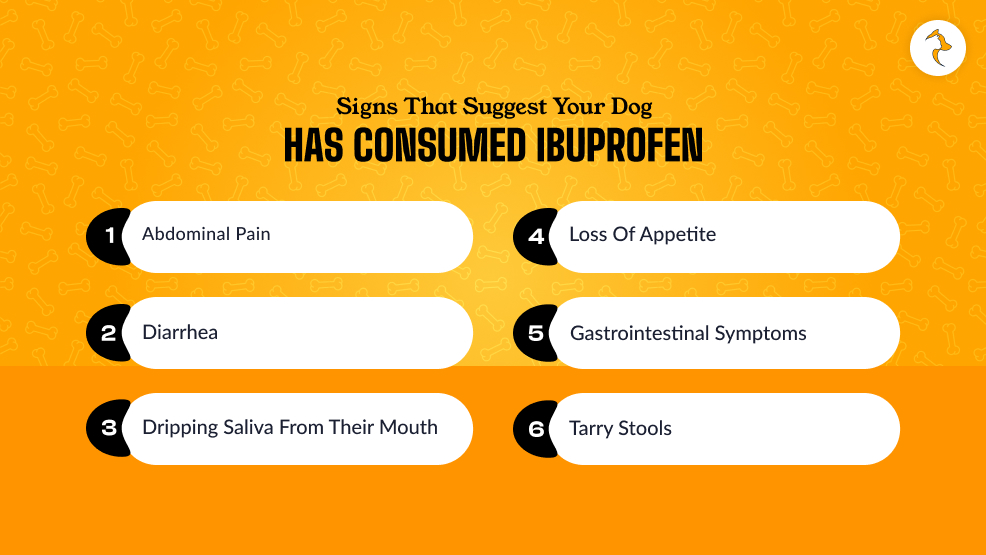
The dog shows various symptoms after ingesting ibuprofen. Moreover, this includes loss of appetite. These dogs often refuse to eat.
Further, they suffer from abdominal pain, diarrhea, and dripping saliva from their mouth. You can also see your dog passing black, tarry stools.
You can also see several gastrointestinal symptoms after two to three hours of ingesting ibuprofen.
Moreover, you should react to the subtle signs as soon as possible, as the serious complications often show up after four to five days of ingestion.
How To Reduce These Risk Factors?
Do not give your dog any medication yourself. Seek recommendations from your vet instead. There are several alternatives to this medication on the market.
Thus, you should ask your vet before giving your dog the medication. Several hospitals and clinics also offer other forms of treatment, such as weight-loss programs, nutritional supplements, physical therapy, and acupuncture.
Avoid using more than one NSAIDs at a time. Do not combine NSAIDs with corticosteroids, such as prednisone. Moreover, using both increases the risk of side effects.
You should provide your dog with a five to seven-day interval before switching to other drugs like NSAIDs or other types of steroids. Do not use ibuprofen for your dog.
Frequently Asked Questions (FAQs)
Here are the answers to some of the most commonly asked questions that people generally ask, along with “Can You Give Dogs Ibuprofen?”
No. Dogs should never consume ibuprofen. Moreover, even the ingestion of the smallest dosage can cause kidney failure, stomach ulcers, seizures, or even death.
Consult your vet for safer pain-relief options for canines. They will suggest alternatives that will not cause issues in the dogs.
Call your veterinarian to save your dog. Even the smallest dosage of the drug can cause terrible consequences.
The pet parents of smaller dogs should be more careful, as the smallest dosage can kill their dogs.
No, Ibuprofen in any quantity is not at all safe for the dogs. The metabolism of dogs is very different from that of humans.
Thus, even the smallest dosage can be life-threatening for small dogs.
The symptoms include vomiting with blood, tremors, seizures, and others. You should rush your dog to the vet immediately if you see these symptoms.
No NSAID remains absolutely safe for your dogs. However, you can go for the other, much safer alternatives such as carprofen, meloxicam, firocoxib, deracoxib, or etodolac.
Do not use any medication without asking your doctor. Consulting with the vet is important.
Human medicines block several prostaglandins that support the proper functioning of the kidney and stomach. These secretions also help in blood clotting.
Moreover, the dogs generally metabolize things differently. Thus, they remain very sensitive to these effects.
Share









Leave A Comment