
Xanax For Dogs: How Does It Work, Side Effects And More

Anxiety in dogs is common, and your vet may prescribe Xanax for dogs to fight it.
But does it really work? What are the situations in which Xanax for dogs or Alprazolam helps?
Also, how does it work?
Here, I will discuss what Xanax for dogs is, the side effects, alternative treatments, and
more.
What Is Alprazolam Or Xanax For Dogs?

Xanax is a sedative drug, and it falls in the class of benzodiazepines. This class of drug works on the CNS or central nervous system of a dog’s body.
Furthermore, Alprazolam is the active ingredient in this medicine, and it causes interactions with gamma-aminobutyric acid or GABA.
Also, gamma-aminobutyric acid or GABA is the neurotransmitter that produces a calming effect by stopping nerve signals.
Thus, Xanax for dogs makes the overactive neurons calm.
Xanax is also a common medicine for human anxiety disorders. Vets now use Xanax for dogs to alleviate canine anxiety in situations such as separation, thunderstorm fear,, or other stress triggers.
Is Xanax For Dogs Good?

Yes, vets prescribe Xanax to fight anxiety in dogs.
However, whether the medicine is good for them depends on many factors, such as:
- The Nature of Anxiety
- Dog Size
- Current Health Condition of the Dog
How Is The Current Health Condition Of A Dog Related To Taking Xanax?
Does your dog have liver issues? They may face metabolism issues if you administer Xanax.
Furthermore, when a dog breed is small, it may be more sensitive to the side effects of Xanax.
Moreover, if the dog is already taking antibiotics, antihistamines, or pain relievers, those may interact with Xanax.
How Does Xanax Work In Dogs?
When there are thunderstorms, sudden fireworks, or other events that cause anxiety, the stressors in a dog’s body get activated.
That happens because of a surge in norepinephrine, a type of neurotransmitter. There is also a serotonin boost.
Now, Xanax, in such cases, binds to the GABA neurotransmitters or receptors to make their brain calm. In other words, this medicine inhibits the neural firing that has become overactive.
What Is The Correct Dose For Xanax?

Now, Xanax works by binding with neurotransmitters. That is why the dose of the medicine is very important.
YOU MUST NOT ADMINISTER THIS MEDICINE WITHOUT PRIOR CONSULTATION WITH THE VET.
Overdosing can be fatal, as it is not just another sedative. It lowers the blood pressure. So, overdosing can cause drop in blood pressure drastically.
Still, ideally, a dog weighing 10 pounds can have a dose of 0.1 to 0.5 mg.
Also, the ideal frequency of the dose is every 8 to 12 hours.
However, remember that Xanax is ideal for short-term use. Because it has a strong physical, psychological, and behavioral effects, you cannot administer it to your dog for long.
That is why you must accompany the medication with behavioral therapies.
Why Is Xanax Used For Dogs?
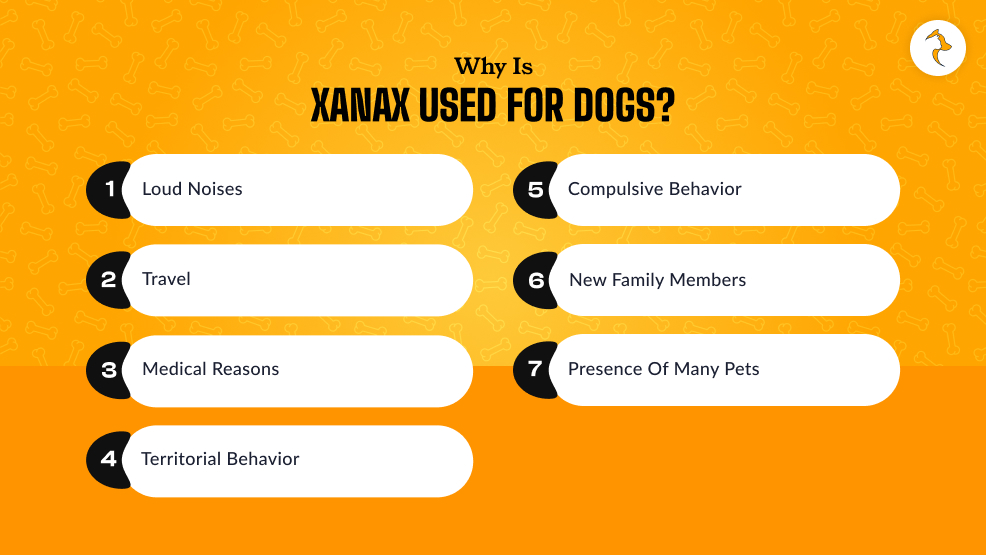
As I have mentioned, Xanax is used for the treatment of anxiety in dogs. However, these are the common reasons for anxiety in dogs.
1. Loud Noises
Fireworks, thunderstorms, and too many speaking loudly, can make a dog anxious.
A vet may prescribe Xanax for dogs in such scenarios to calm their minds.
2. Travel
When a dog is traveling for a long distance by road, or they are taking a flight, they will feel anxious.
Furthermore, there can be motion sickness. While Benadryl is the most common medication in such cases, Xanax works for dogs with severe symptoms.
3. Medical Reasons
Has your dog undergone surgery recently? Or, is it recovering from a prolonged injury?
It may feel anxious during the recovery period. Also, the pain and discomfort after a surgery can make the stressors in their bodies active.
Xanax can reduce their anxiety by inhibiting brain functions.
4. Territorial Behavior
Sometimes, dogs engage in excessive territorial behavior out of anxiety. They are especially territorial about their food or partners.
Too much territorial activity also leads to destructive actions such as chewing or excessive barking.
Also, their behavior becomes excessively territorial, and they need therapies and medications such as Xanax.
5. Compulsive Behavior
We all love it when our dogs wag their tails out of happiness. However, do you know that an excess of it is a sign of compulsive behavior?
In this context, remember that excessive licking is also another sign of compulsive behavior.
If your dog is showing such compulsive behavior, the vet can suggest Xanax.
6. New Family Members
Transitions are difficult for dogs. So, when there is a new addition to the family, or you are bringing another pet home, it creates an environment of stress for the dogs.
They become hyper alert as the stressors in their bodies become overactive in such scenarios.
7. Presence Of Many Pets
If your household has many pets, there will always be tensions among them, especially during the initial days.
Now, Xanax can be a short-term solution to alleviate anxiety in dogs in such scenarios.
However, in such cases, behavioral therapies and other long-term plans are more effective.
What Are The Common Side Effects Of Administering Xanax For Dogs?
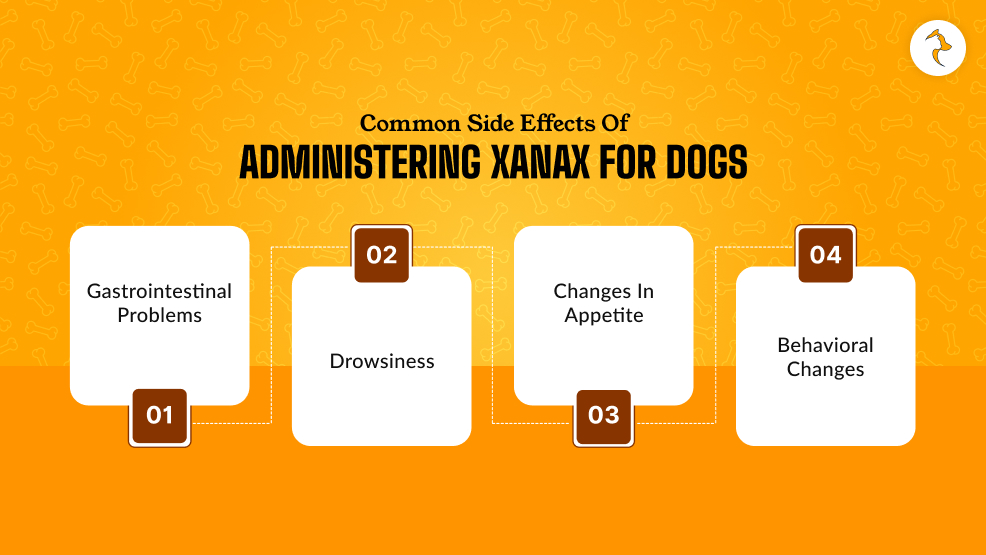
Xanax, being a powerful neuroinhibitor, has many side effects. Also, I have mentioned, if there is an overdose, it can cause death, and don’t take this as a regular disclaimer sentence.
1. Gastrointestinal Problems
Gastrointestinal problems are common in dogs taking Xanax. It can be allergic reactions or interactions with other ongoing medications.
2. Drowsiness
Xanax makes dogs calm. However, as a side effect, the dog can feel lethargic and drowsy.
However, some amount of sedation is intended or natural, if it’s intense, it can really call for medical attention.
3. Changes In Appetite
Xanax can affect the appetite of your dog big time. There can be a sudden increase or decrease in the appetite.
So, if your dog is taking Xanax, you need to monitor them regularly while feeding.
4. Behavioral Changes
The behavioral changes in dogs will vary. Due to Xanax, some dogs can act overly affectionate, while others can act detached.
There can also be disorientation in the behavior.
That is why behavioral therapies can be a wonderful addition or alternative to Xanax as a long-term plan.
Share









Leave A Comment