
A Complete Care Guide For Freshwater Angelfish

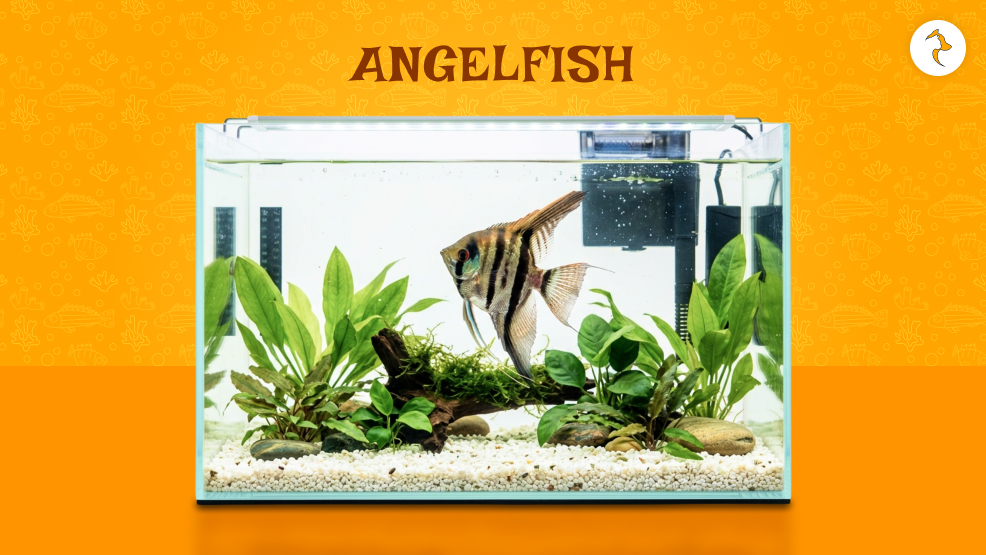
Angelfish is one of the most recognized fish in the aquarium hobby. It belongs to the Cichlidae family.
Moreover, people love this fish for their incredible swimming pattern. Hence, most of the hobbyists think of keeping angel fish in large community aquariums.
You will find fewer wild-caught Angelfish in the aquarium hobby. Most of the fish in the pet shop are bred in captivity only.
Naturally, there is only one type of Angelfish in the wild. These fish come with #545557 vertical stripes.
On the other hand, breeders produce several long-finned, colorful varieties through selective breeding.
These long-tailed varieties are often known as “veiltails” for their ginormous fins and mesmerising looks.
Most of the Angelfish in the aquarium are the Pterophylllum scalare. However, you can rarely find P. Altum.
The. Pleopoldi is the fastest and smallest species of Angel fish. However, it is almost never seen in the hobby.
How To Care For A Freshwater Angel Fish?
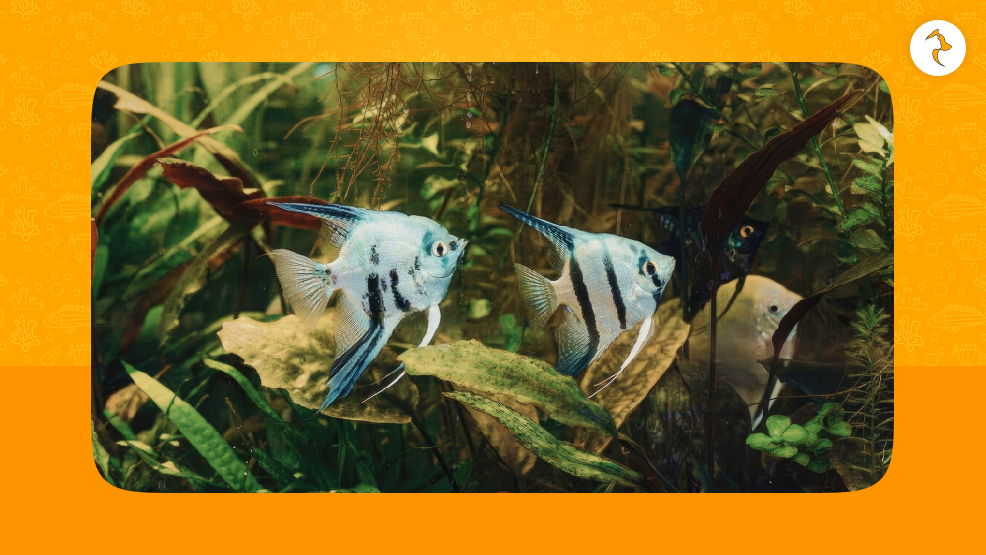
You should create an aquarium that properly mimics the habitat of an Angelfish. Hence, here are the main things to consider when creating the ideal aquarium for your Angelfish.
1. What Is The Natural Habitat Of An Angel Fish?
The Angelfish comes from tropical South America. They are mostly found in the Amazon River system.
Freshwater angelfish are generally found in quiet, slow-moving waters in their natural habitat. They prefer lit areas. These places are generally found under an overhanging vegetation.
2. What Are The Required Water Parameters For Angelfish?
Captive-bred and raised angle fish can live in a wide range of water conditions. However, they generally prefer mildly warmer water.
Hence, the water should have a pH of between 6.8 and 7.8. On the other hand, the hardness should be around 54 to 145 ppm.
You should always maintain a temperature between 78° and 84° F. Additionally, you should do a 10% or 25% water change every other week.
3. Housing Needs And Requirements Of Angelfish?
Angelfish generally grow large. Thus, they need an aquarium larger than 55 gallons when they become fully grown.
Angelfish need a tall aquarium. Moreover, the tall aquariums make them look gorgeous. They generally prefer broad-leaf aquatic plants and driftwood.
You should also add floating plants to provide you with cover for shaded areas. You should add medium-grade substrates and use only gravels with a smoother surface. Angelfish often go to the bottom of the tank to search for food.
Aquarists often add angelfish to planted aquariums. However, avoid keeping them with the small fish.
4. What Is The Behavioral Nature Of The Angelfish?
Angelfish generally tend to be peaceful. However, they are often aggressive toward one another.
They especially get aggressive when they have to pair and spawn. Angelfish can eat any smaller fish that fits into their mouth.
When choosing suitable tankmates for Angelfish, be careful. You cannot add various fish to the Angelfish tanks.
Suitable tankmates include Rasbora, Peaceful Barbs, Guramis, Ghost Knifefish, and Pleco Fish. Further, you can add various corridors and the medium-sized catfish with Angel Fish.
You can also keep Angelfish with Discus Fish. However, the temperature should be above 82° F.
5. What Is The Dietary Needs Of Angelfish?
Angelfish generally feed at the surface level or at the bottom middle. However, occasionally they come to the bottom to search for worms and small crustaceans.
They are omnivores and hence can consume tropical flakes, shrimp pellets, frozen worms, and several other foods.
Feed them things that they can consume within a few minutes. Moreover, this will prevent residues from building up at the bottom of the tank. Hence, the water quality will remain better.
6. What Are The Mating Habits Of The Angelfish?
Angelfish, unlike the other fish, generally form a monogamous pair. Thus, a pair of Angelfish stays together throughout their lives.
Monogamy is a very rare behavior among fish. Thus, the Angelfish is one of the most unique fish in the world.
A pair of Angelfish has to do proper teamwork. Hence, one parent protects the eggs from the other fish while the other goes to bring food.
In addition, the angelfish also use their tail to constantly wave the water towards the eggs. They generally do this to keep the eggs oxygenated.
The parent fish also keeps the fungus and parasites at bay while fanning the eggs with their fins.
The adult angelfish pair off and spawn quite easily. They generally search for a flat surface that is vertical before laying their eggs.
They also try to chase the other fish during this process. The female lays the eggs on a vertical surface, and then the male slowly fertilizes them.
Most of the captive-bred Angelfish often lose their caring instinct. Thus, they often end up eating their own fries.
Breeders often induce Angelfish pairs to spawn on vertical pieces of stone or slate. Then they remove the hatchlings to raise them into adult fish.
7. How Long Do Angelfish Live?
The lifespan of Angelfish depends on the subspecies of the fish. Moreover, most of the Angelfish can live for more than a decade.
While the freshwater Angelfish can live for more than eight to twelve years, proper care allows the Angelfish to have a long, happy life.
8. What Are The Different Patterns And Colors On Freshwater Angelfish?
Freshwater Angelfish generally come in a variety of patterns. These patterns include striped, marbled, solid, and koi.
Each of them looks very different from the others. However, the shape and pattern of the fish generally remain the same. However, the fin shapes can vary.
The freshwater Angelfish can be found in various colors, including white, gold, and silver.
Frequently Asked Questions (FAQs)
Here are the answers to some of the most commonly asked questions about freshwater angelfish.
The Freshwater Angel Fish generally tends to be very territorial. Thus, you should keep either a single fish or a mated pair.
These fish generally cause less harm to the other fish. However, they can be aggressive towards each other.
You should avoid keeping any small fish that fits into the mouth of the Angelfish. The Angelfish is an omnivorous fish.
Thus, Angelfish often eat the smaller fish. On the other hand, fast-moving and aggressive fish like silver dollars and others can also harm Angelfish.
The Freshwater angelfish is considerably gentler than the other fish. Thus, they should not be subjected to high water flow.
Share







Leave A Comment