
Why Is My Dog So Itchy? What Causes A Dog To Scratch Constantly?


Persistent itching is one of the most problematic things. Hence, the pet owners often seek veterinary assistance for this.
Itching can refer to several things, including seasonal allergies as well as issues related to fleas. Hence, the vets generally seek help for this reason.
In this article, we will learn about the most common reasons for a tdog to persistently scratch. We will also learn about the major remedies that can help your dog during these situations.
This condition can happen due to mild reasons as well as severe reasons. Thus, you should immediately connect with a professional to determine the major reasons.
In this article, we will try to find a relevant answer to the question “Why is my dog so itchy ?”
Why Is My Dog So Itchy? What Are The Underlying Reasons?

Continuous scratching can be caused by various reasons. This can include things like irritation, inflammation, and involvement of external parasites.
The milder causes can be easily taken care of at home. However, the larger and more severe problems generally require dedicated veterinary support.
This is more relevant as the serious underlying causes can be fatal for the dog as well. Going to a vet can easily prevent long-term discomfort and infection.
Moreover, the common reasons for constant itching can be things like. Allergies, that can be triggered by several ways, including food, environmental factors, and contact allergens.
In addition to this, issues like fleas, ticks, and mites, infections on the skin, and other hormonal issues can also make your dog feel itchy.
People should understand all the underlying causes. This shall provide your dog with long-term relief.
What Are Common Reasons For Dog Scratching?
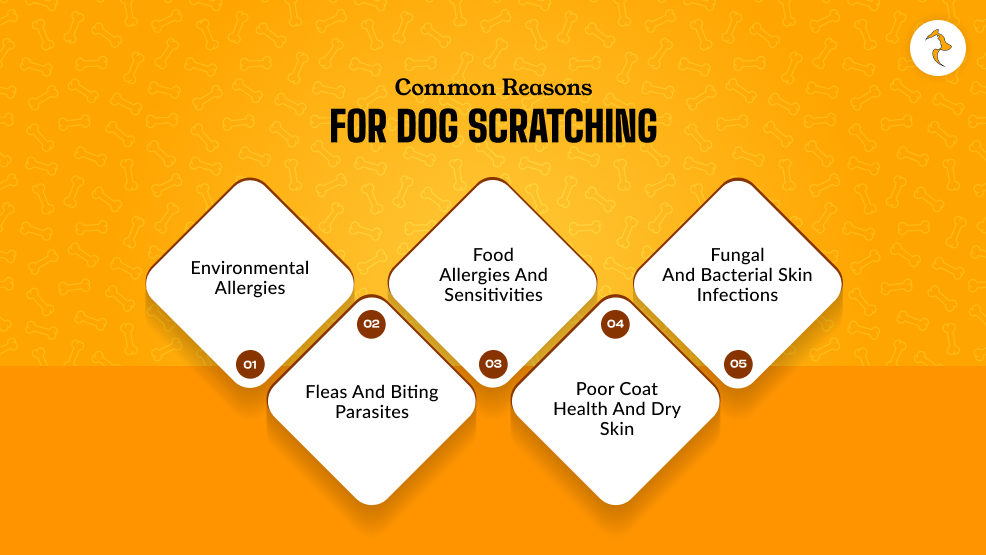
A dog can scratch for multiple reasons. Here are some of the main reasons behind a dog’s scratching. Hence, let’s find an answer to the question “Why is my dog so itchy ?”
1. Environmental Allergies
Environmental allergies often cause major issues, such as chronic itching. A dog’s reaction to a bite can be due to several things, such as mold spores, dust mites, cleaning solutions, or even grass.
Moreover, these things can lead to several issues, such as red, itchy paws. In addition to his, a dog can also show signs like scratching its ears and constantly shaking its head.
Furthermore, the dog can also develop issues such as belly and armpit rashes.
Thus, in these situations, you should follow a few steps to help your dog. You should always take your dog for clinical allergy tests.
This helps you accurately understand the main reason behind environmental allergies. Pet parents can also wipe their dog’s paws before bringing it back home.
In addition, using hypoallergenic shampoos can also help dogs in multiple ways. Always ask your vet about the right medication.
2. Fleas And Biting Parasites
A small flea bite can lead to several days of scratching. This becomes even more terrible for dogs with flea allergy dermatitis.
These fleas can easily infest the areas near the tail base, groin, or even belly. You should look out for certain signs when your dog gets flea bites.
Moreover, these signs include tendencies such as biting the tail and legs. You will be able to see flea dirt that looks like tiny black specks.
In addition, fleas cause hair loss in specific areas. Thus, you will find patches of bare skin in certain areas.
Dogs can also start scratching after spending time outdoors. Hence, you should always check out relevant dog flea remedies.
This includes deworming, grooming, and cleaning upholstery. In addition, you should take your dog to the vet if it has an infection.
3. Food Allergies And Sensitivities
Food allergies generally start with gut health problems. However, eventually, they definitely exacerbate the skin issues.
Dogs often react to certain types of protein, such as beef, chicken, and dairy. Thus, during these times, the vets often suggest hydrolyzed protein for dogs.
Thus, you should observe your dog for certain symptoms like itchy ears, constant paw licking, and skin infection that keeps coming back.
The dog can also suffer from gastrointestinal upset in severe cases. The veterinarians can recommend a food diet that involves limited food ingredients.
Proper treatment and hypoallergenic trial by the veterinarians for at least 9-12 weeks can easily help in the identification of the main trigger.
4. Poor Coat Health And Dry Skin
In the dry and semi-arid areas, a dog can suffer from dryness. Low humidity, weather changes, and bathing frequently can easily strip all the natural oils from the coat of a dog.
The signs of poor coat health include things like rough patches in the skin, flakiness, mild itching, and others.
There are several home remedies for these issues. Hence, these things include mild itching, flakiness, brittle or dull fur, and most importantly, it can also lead to mild itching.
You can use simple home remedies to treat these issues. You should use moisturizing shampoos. Adding fatty acids like omega-3s can also help a vet in multiple ways.
Pet parents should not overbathe a dog with poor coat conditions.
5. Fungal And Bacterial Skin Infections
Excessive scratching can lead to breaking of the skin. This allows bacteria or yeast to infect the skin of a dog. The infections generally worsen when a dog does not receive proper medical care.
Moreover, the symptoms can include things like red, irritated skin, followed by a very strong odor. In addition, the dog can also develop darkened patches.
Things To Remember About Itchy Dogs
A dog can be itchy for multiple reasons. Moreover, this can include mild reasons, and in some cases, the reasons can be serious.
Thus, you should always consult with your vet whenever you think your dog is acting itchy.
Some cases can be easily dealt with through home remedies, while some require veterinary intervention.
Share








Leave A Comment